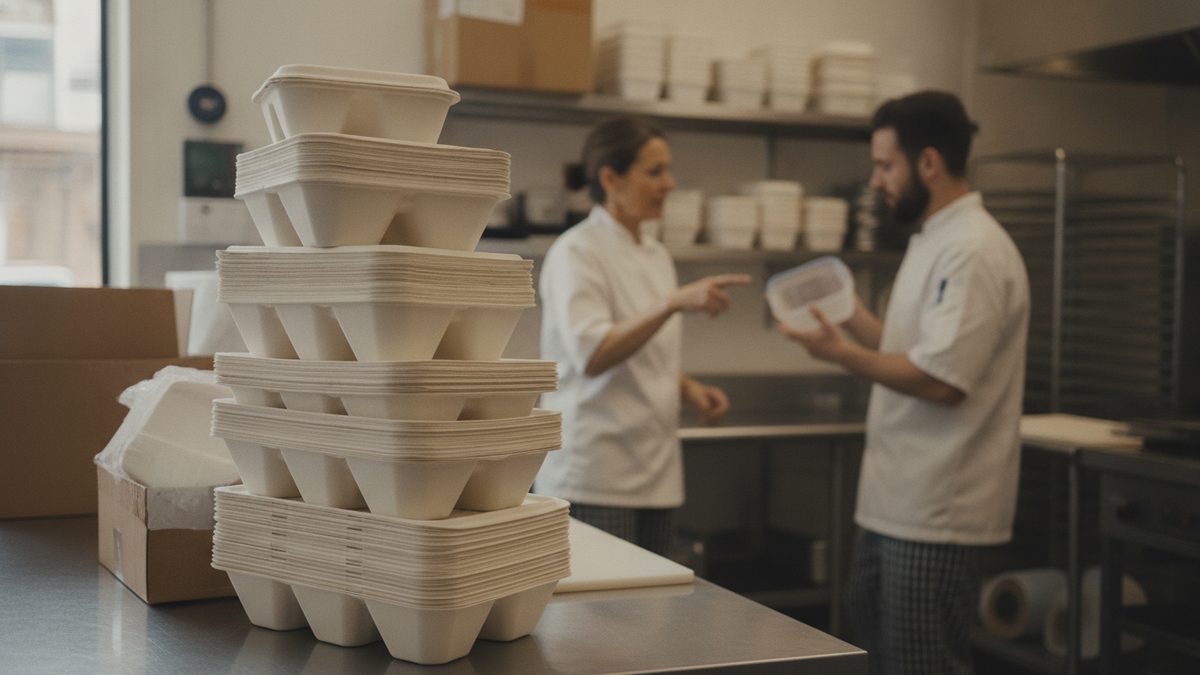
To reduce takeout packaging costs, first measure what each order really costs you in containers, bags, utensils and napkins, then standardize to fewer sizes, buy in bulk from two suppliers, stop auto-including extras, and price packaging into your to-go menu. Most restaurants find 15% to 30% savings without guests noticing, because the waste is hiding in oversized boxes and unrequested add-ons.
Start by costing the package
Most owners know their food cost on a plate but have no idea what the box, lid, bag, fork, napkins and sauce cups add up to. Packaging often lands between $0.50 and $2.50 per order, and on a $22 ticket that can quietly eat 5% to 10% of the sale. Delivery orders pile on tamper-evident seals and extra bags.
Build a "package cost per order" the same way you cost out a recipe. List every item that leaves with an order, multiply by its unit price, and add it up for your three most common order types.
| Item | Unit cost | Qty per order | Cost |
|---|---|---|---|
| 32 oz container + lid | $0.38 | 1 | $0.38 |
| Paper bag | $0.12 | 1 | $0.12 |
| Utensil kit | $0.09 | 1 | $0.09 |
| Sauce cups (2) | $0.04 | 2 | $0.08 |
| Napkins | $0.02 | 3 | $0.06 |
| Total | $0.73 |
Multiply that by weekly to-go orders. At 400 orders a week, $0.73 per order is nearly $15,200 a year, which makes a 20% cut worth about $3,000.
Where the savings usually hide
Right-size your containers. A half-empty box wastes money and makes food look skimpy. Pick two or three sizes that fit your menu instead of five. Fewer SKUs also means better bulk pricing and simpler inventory.
Stop automatic extras. Ask guests whether they need utensils, napkins and condiments, or let online ordering make it a checkbox. Many operators see utensil use drop sharply once it is opt-in.
Standardize across the menu. If two entrees can share a container, they should. Test the swap with your best sellers first and check that sauces and fried foods still travel well.
Reconsider specialty packaging. Custom-printed boxes look great but cost more per unit and require large minimum orders. Use a branded sticker or stamp on a stock container to get most of the effect for a fraction of the price.
Negotiate and compare suppliers
Packaging is a commodity, so shop it. Get quotes from your broadline distributor, a restaurant supply warehouse and one online wholesaler, and compare cost per unit at the same case size. Our guide on negotiating better prices with your vendors applies directly, and bulk buying only makes sense if you have dry storage and the item will not change.
Ask for price protection for 90 days. Paper and plastic prices move with commodity costs and tariffs, so lock in what you can before the holiday volume.
Charge for it the smart way
You do not have to absorb every cent. Three options work:
- Build it into menu prices. Raise to-go prices slightly, which is covered in how to price your menu for takeout and delivery.
- Add a small packaging fee of $0.50 to $1.00, clearly labeled. Check local rules, since some cities regulate fees or require disclosure.
- Offer premium add-ons like extra sauces for a small charge.
Whichever you choose, be transparent. A surprise line item at checkout hurts reviews more than it helps margin.
Packaging is a cost of goods, not overhead. Track it per order, and it becomes just another line you can manage down.
Control the leaks
Track waste in your waste log: crushed boxes, wrong sizes grabbed in a rush and open sleeves that get contaminated. Store packaging near the pack station, labeled by size, so staff do not reach for the biggest box out of habit. Reorder with par levels so you never pay rush shipping.
Also steer more guests to your own channels, where you control the packaging and keep the margin. Getting customers to order direct beats delivery apps on both commission and packaging requirements.
Use your POS to prove the savings
Add packaging as a line in your costing and compare it month over month. With Cobblestone POS, commission-free online ordering lets you set utensil and condiment choices as opt-in, and reporting shows to-go order counts so your packaging math stays accurate, all with no monthly fee.
Quick checklist
- Cost your package per order type.
- Cut to two or three container sizes.
- Make utensils and napkins opt-in.
- Get three supplier quotes and ask for price protection.
- Price or fee packaging transparently.
- Review packaging cost per order monthly.
Use the attached calculator to see your annual packaging spend and the savings from each change.
Free Takeout Packaging Cost Calculator (Excel).